 bitdispatcher
Free and open source · Apache 2.0 · 911 dispatch
The 911 dispatch system that is one program and one web page
bitdispatcher is a complete computer-aided dispatch system for 911 centres: incidents, units recommended by road time, a dispatch map that works with no internet, a screen for every monitor at the console, mark-outs and status checks, a supervisor board and a mobile terminal for the crews. Set up entirely in the browser.
One press: Sign in as the demo user on its sign-in page. Or sign in as demo
with password try-bitdispatcher-demo.
A dispatcher's console on invented data around Roanoke, Virginia. Simulated 911 calls arrive every 35 seconds; it goes back to the morning's incidents every night.

Built for the dispatcher
Everything a small or mid-size 911 centre needs, done reliably
The large CAD vendors price out the counties and cities that need dispatch the most. bitdispatcher is one program, free, with its source: no server farm, no database to stand up first, no per-seat licence.
A console with nothing wasted
911 calls ringing before they are answered, incidents with priority timers, the map, the incident and every unit's status on one screen, and a command line for everything.
Units recommended by road
Run cards by capability and road time, counting what is already on scene, saying what is short and which stations would be left empty. One keystroke sends them.
A screen for every monitor
Calls, fire houses, police, units, the map and the incident, each on its own monitor, opened in one click and remembered for the position. Choose an incident on one and the others follow.
Fire, EMS and police together
A fire-house board with bays and move-ups, police mark-outs with where each officer is and a timer for every status check, and a screen limited to one discipline when that is wanted.
A map that works with no internet
OpenStreetMap, the county's address points and aerial photos recorded for a 100-mile circle: dispatch styling, road routing and address search, all local.
A mobile terminal for the crews
The assignment, the route, the premises' hazards, notes from dispatch, statuses on the F-keys, mark-outs, GPS and the emergency button, on any tablet or laptop.
Reports nobody retypes
Incident reports with NIBRS checked, Virginia's incident-based reporting file in one click, NCIC inquiries, and the daily operations report built from the ledger.
A record that cannot quietly change
Every decision in an append-only, hash-chained ledger, verified from the browser; several sites active-active, each working on when cut off.
For the supervisor
Where the work is piling up
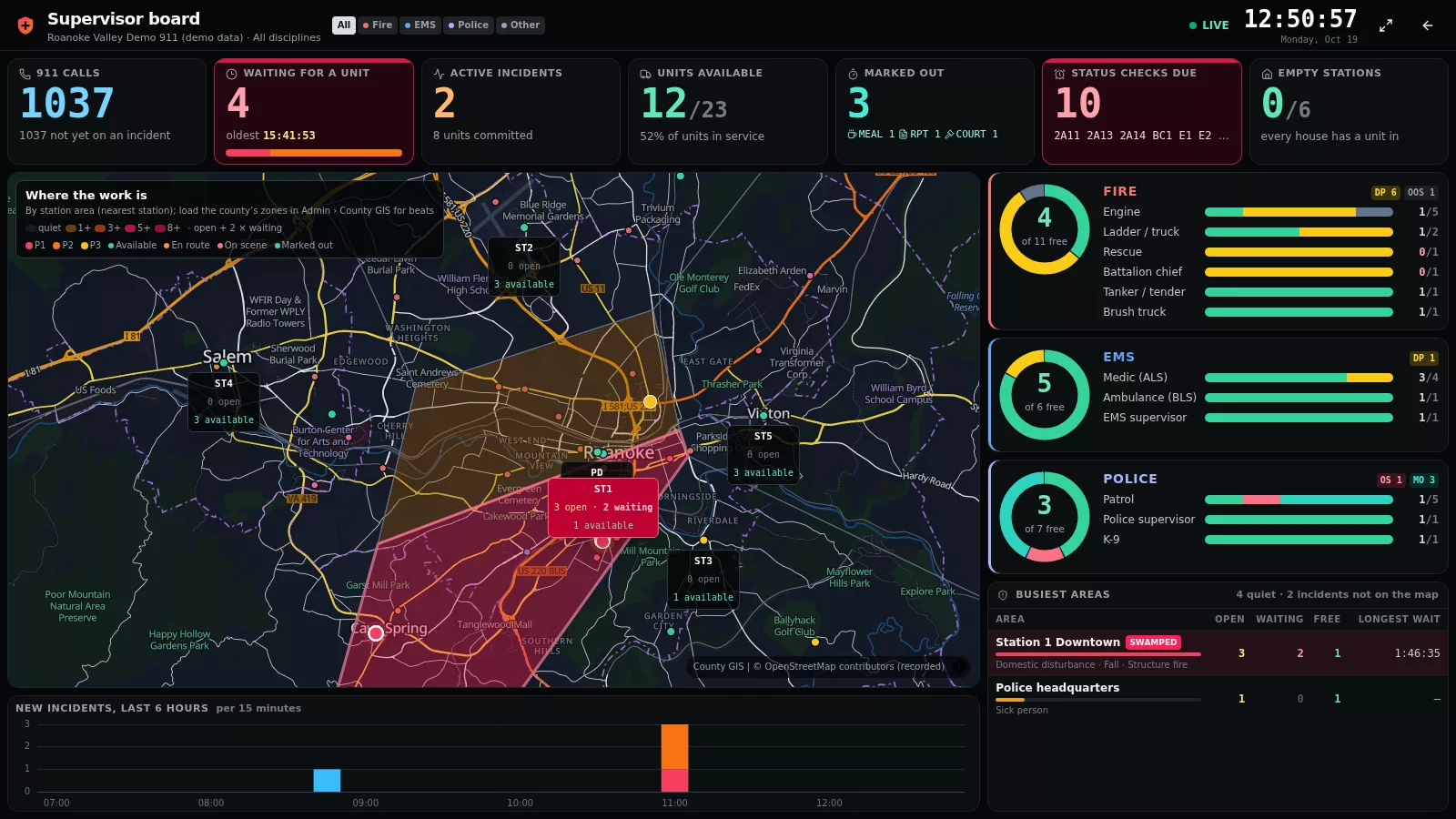
What is free, what is waiting and for how long, the status checks due and the stations left empty, with the county shaded by how busy each area is. Read-only, for the wall or the supervisor's desk.
- Each discipline's units, type by type
- The busiest areas, with what is open and the longest wait
- New incidents over the last six hours
Police
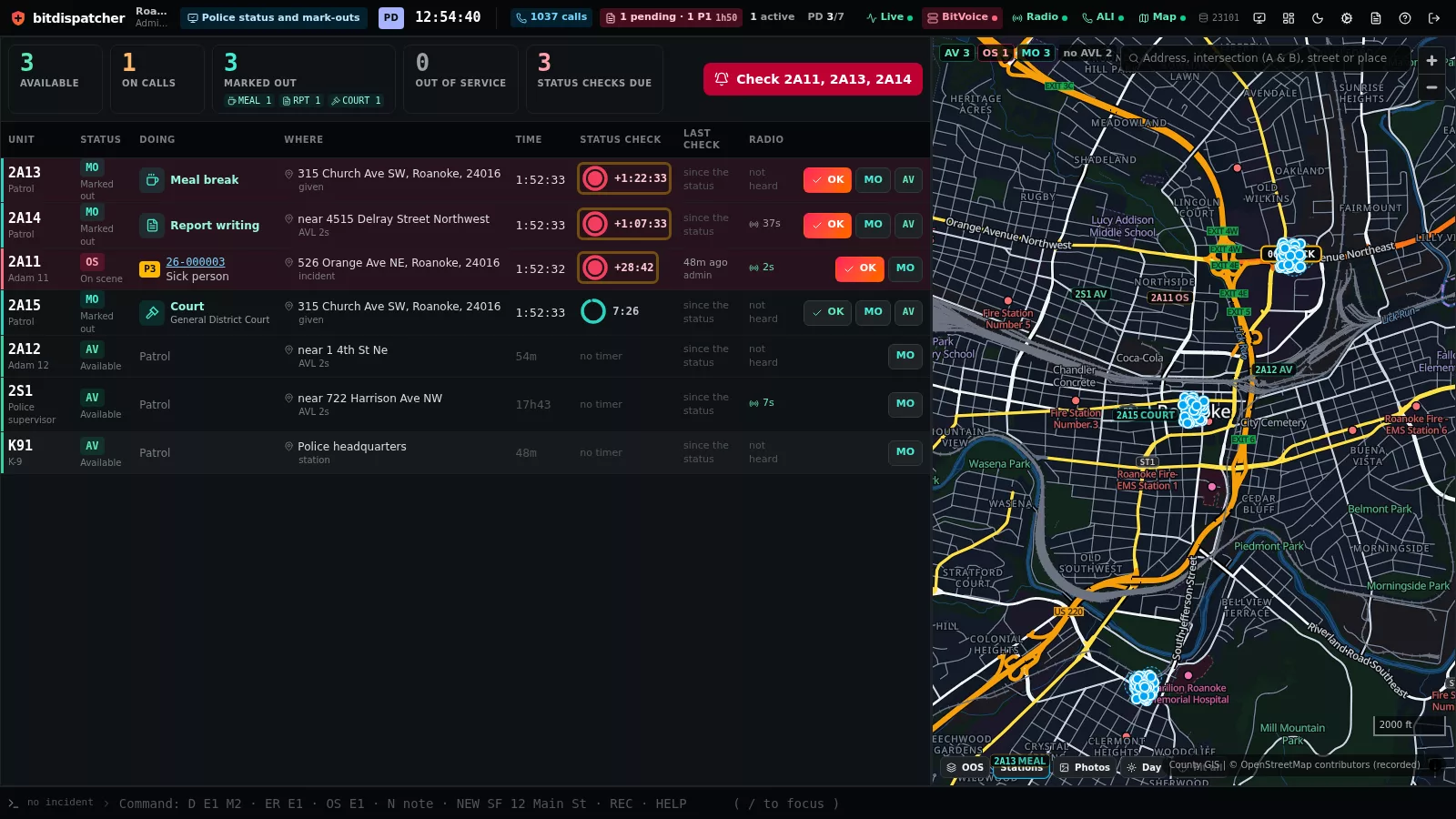
Every car, what it is doing, and when to check on it
Meal, court, a traffic stop, a business check: each mark-out with where the officer is and its own status-check timer. An overdue check flashes; SC 2A12 clears it, and a car on an interruptible mark-out is offered when nothing else is free.
Fire and EMS
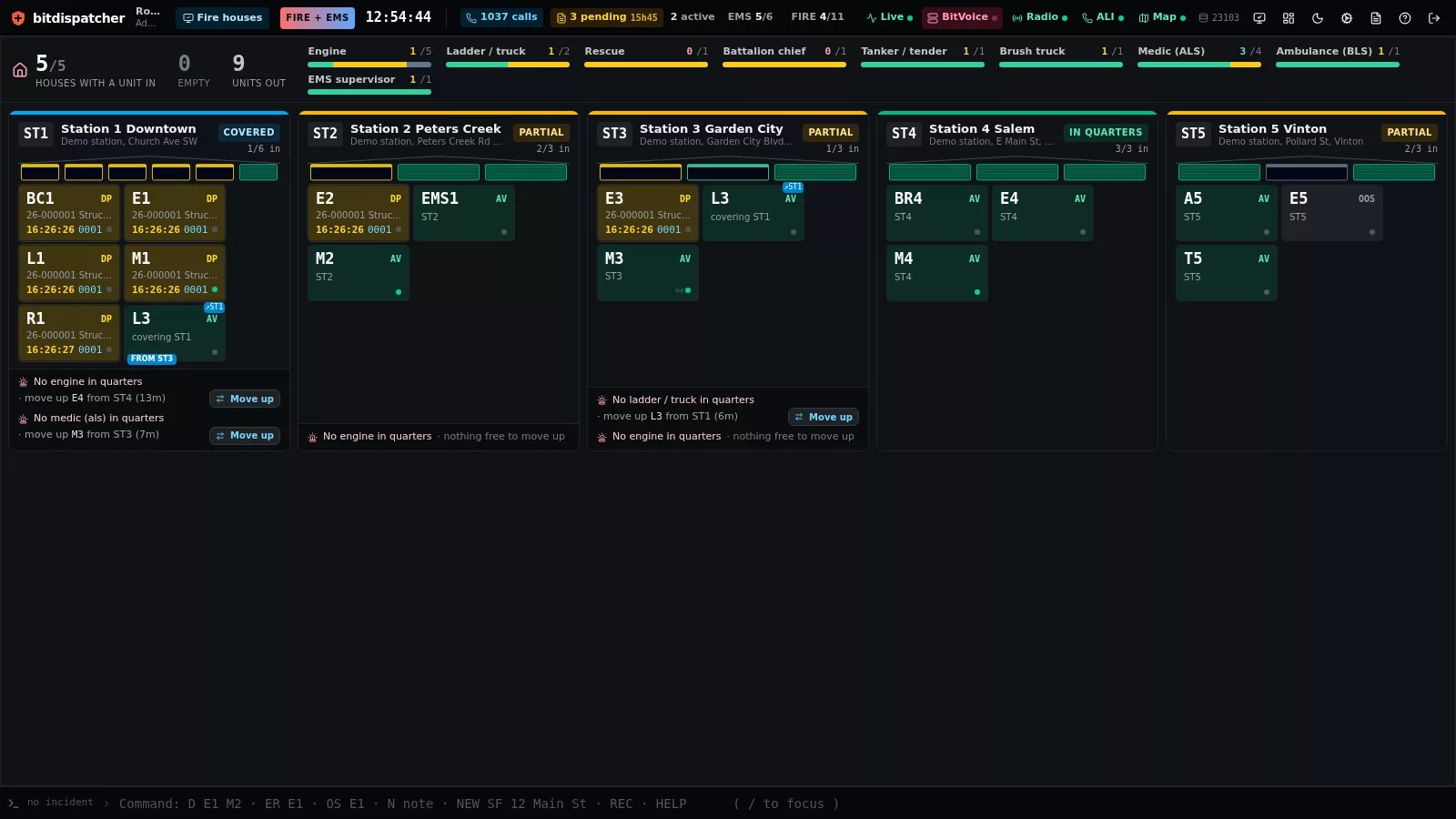
The fire houses, bay by bay
Every station with what is in quarters, who is out and who is covering. When a house is left without an engine or a medic, the nearest move-up by road is one click.
At the keyboard
A command line for everything
Dispatchers who type never reach for the mouse. Every command completes with Tab, keeps its history, and says why when it is refused.
Plainly
What is proven, and what is not yet
Every change runs the Go tests and browser tests that dispatch calls from the BitVoice simulator, work the mobile terminal, and open screens on three monitors. bitdispatcher is not certified and not yet in service anywhere; the proof page says exactly what has been tried against the real thing and what has not.
Work a shift in the demo
Press Sign in as the demo user. Take the 911 calls, make them incidents, send the units.